
Blog
Anubis Is the God of What? Meaning & Egyptian Mythology

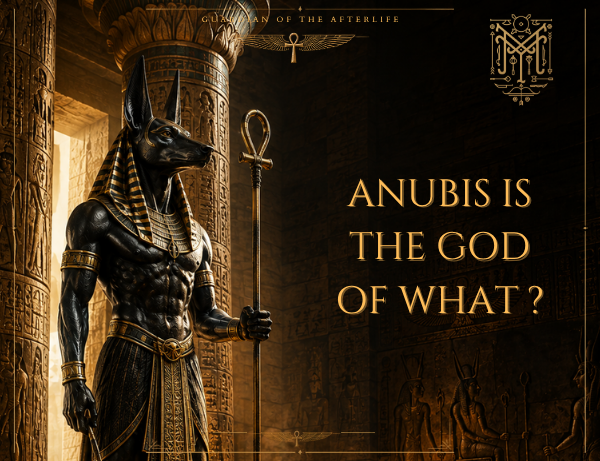
Anubis Is the God of What ? Anubis is the ancient Egyptian god of mummification, embalming, funerary rites, and the protection of the dead. He was also closely associated with tombs, cemeteries, and the journey of the deceased into the afterlife.
Anubis Is the God of What?
Recognized by his distinctive jackal or canid head, Anubis is one of the most recognizable figures in ancient Egyptian mythology. For thousands of years, Egyptians associated him with the protection and preparation of the dead and with important rituals surrounding burial and the afterlife.
But Anubis was much more than simply the “god of death.” His role was connected to preservation, protection, judgment, and the transition between death and the afterlife.
In this guide, we explore who Anubis was, what he represented, why he had the head of a jackal, and why his image became such an important symbol in ancient Egyptian art.
Anubis is primarily known as the god of mummification and embalming in ancient Egyptian religion.
He was also associated with:
- Mummification and embalming
- Funerary rituals
- Protection of the dead
- Tombs and cemeteries
- The transition to the afterlife
- The protection of mummies
- The weighing of the heart during judgment
The Metropolitan Museum of Art describes Anubis as a jackal-headed god who oversaw embalming and protected the necropolis. He also played an important role in the judgment of the dead by supervising the weighing of the heart.
This is why calling Anubis simply the “god of death” is not entirely accurate.
A better description is that Anubis was a guardian and guide associated with death, burial, mummification, and the journey to the afterlife.
Who Was Anubis in Ancient Egyptian Mythology?
Anubis, known by names including Inpu, Inpw, and Anpu, was one of the ancient Egyptian deities associated with funerary practices.
His importance developed very early in Egyptian history. His image appears in funerary contexts from the early dynastic period, demonstrating the long-standing importance of jackal-associated funerary imagery.
The exact nature of Anubis’s role changed over the many centuries of ancient Egyptian religion.
In earlier traditions, Anubis was strongly connected with the dead and funerary protection. Later traditions increasingly emphasized his role alongside Osiris, the god who became one of the principal rulers associated with the afterlife.
The result is a complex religious tradition in which Anubis and Osiris had different but complementary roles.
Why Does Anubis Have a Jackal Head?
One of the most recognizable features of Anubis is his jackal or wild-dog-like head.
Ancient Egyptian artists commonly represented Anubis as either:
- A human figure with the head of a canid, or
- A completely recumbent black jackal or canid.
The association probably relates to the behavior and habitat of jackals and other wild canids around ancient Egyptian burial grounds.
The Metropolitan Museum of Art explains that jackals were closely associated with mummification and the journey of the deceased. Their presence around cemeteries may have contributed to their association with funerary protection.
Rather than viewing the jackal simply as a symbol of evil or death, the ancient Egyptians could interpret the animal’s presence around burial places as connected to guardianship and protection.
This helps explain why Anubis became such a powerful guardian figure.
What Does Anubis Look Like?
Anubis is usually depicted in one of two major forms.
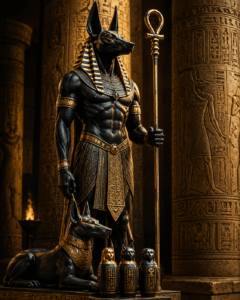
Anubis as a Human With a Jackal Head
In this form, Anubis has:
- A human body
- A black jackal or canid head
- Upright ears
- A long muzzle
- A divine headdress or clothing
- Sometimes a staff or other ceremonial object
This is one of the most familiar representations of the god.
Anubis as a Recumbent Jackal
Anubis was also represented as a black jackal lying down with its head raised.
This form emphasizes his role as a guardian.
The Metropolitan Museum has a limestone statue of Anubis represented entirely as a recumbent canid, dating to the Late Period–Ptolemaic Period.
These artistic representations are among the reasons Anubis remains one of the most popular subjects in modern Egyptian-inspired art and sculpture.
What Does the Black Color of Anubis Mean?
Anubis is frequently represented in black.
The black color had important associations in ancient Egyptian culture.
Black was connected with the fertile soil deposited by the Nile and therefore with ideas of fertility, regeneration, and renewal.
This makes Anubis’s black appearance particularly interesting.
Although Anubis was connected with death and funerary rituals, his symbolism was not necessarily about permanent destruction. Ancient Egyptian beliefs about death were strongly connected with rebirth and continued existence.
Anubis therefore belongs to a religious world in which death and renewal were closely connected.
Anubis and Mummification
One of Anubis’s most important roles was his connection with mummification and embalming.
Mummification was a central part of elite Egyptian funerary practice because preserving the body was believed to be important for the deceased’s continued existence.
Anubis was associated with the rituals performed to prepare the body for burial.
The Metropolitan Museum describes him as the god responsible for embalming and the protection of mummies.
In artistic representations, Anubis may appear beside a mummy, performing ritual actions, or guarding the deceased.
Priests involved in funerary rituals could also wear masks representing Anubis.
This created a symbolic connection between the human priest performing the ritual and the divine protector associated with embalming.
Anubis and the Weighing of the Heart
One of the most famous scenes involving Anubis appears in Egyptian funerary texts and representations of the judgment of the dead.
In this scene, the deceased’s heart is weighed against the symbol of Ma’at, representing truth, justice, and cosmic order.
Anubis is frequently shown supervising or operating the scales.
The Metropolitan Museum’s description of the Book of the Dead Papyrus of Tiye identifies Anubis as the jackal-headed god of embalming who operates the scales during the weighing of the heart.
The basic idea was that the deceased’s moral condition was examined before entering the blessed afterlife.
If the heart was found to be in harmony with Ma’at, the deceased could continue toward the afterlife.
This makes Anubis not only a protector of the dead but also an important figure in the transition between death and judgment.
Anubis and Osiris: What’s the Difference?
Anubis and Osiris are sometimes confused because both are strongly connected with the ancient Egyptian afterlife.
However, they had different roles.
Anubis
Anubis was primarily associated with:
-
Anubis
Embalming
- Mummification
- Funerary rituals
- Tomb protection
- The protection of the dead
- The weighing of the heart
Osiris
Osiris became one of the most important gods associated with:
- The afterlife
- Resurrection
- Regeneration
- The deceased
- The judgment and realm of the dead
In simple terms:
Anubis helped protect and prepare the dead, while Osiris was the principal ruler associated with the realm of the dead.
Their roles were complementary rather than identical.
Is Anubis the God of Death?
This is one of the most common questions about Egyptian mythology.
The short answer is:
Not exactly.
Anubis is often called the “god of death” in popular culture because he is strongly associated with death, tombs, mummies, and the afterlife.
However, his more specific traditional roles were related to mummification, embalming, funerary rituals, protection of the dead, and the transition into the afterlife.
This distinction matters because ancient Egyptian religion did not treat death simply as an ending.
Death was part of a larger process involving preservation, judgment, and the possibility of continued existence.
What Is Anubis the God of in Egyptian Mythology?
If you are looking for a simple answer to “Anubis is the god of what?”, the most accurate summary is:
Anubis is the ancient Egyptian god of mummification, embalming, funerary rites, and the protection of the dead. He was also associated with tombs, cemeteries, and the judgment of the deceased.
His role made him one of the most important divine figures connected with ancient Egyptian burial traditions.
Anubis Symbols
Anubis is associated with several powerful symbols.
The Jackal
The jackal is Anubis’s most recognizable symbol.
It represents his connection with cemeteries, burial grounds, protection, and the world of the dead.
The Color Black
Anubis is frequently depicted in black.
The color can be connected with the fertile soil of Egypt and ideas of regeneration and renewal.
The Ankh
The ankh, one of the most famous symbols of ancient Egypt, represents life and is frequently associated with Egyptian gods.
Although the ankh is not exclusive to Anubis, it can appear in Egyptian religious art involving various deities.
The Scales
The scales are associated with the weighing of the heart.
Anubis is often shown supervising this important stage of judgment.
The Burial Chamber
Anubis’s association with tombs and burial spaces reflects his role as a protector of the deceased.
Anubis in Ancient Egyptian Art
Anubis became an important subject in Egyptian sculpture, painting, funerary objects, amulets, coffins, and religious artifacts.
His distinctive appearance made him immediately recognizable.
Ancient Egyptian artists represented him in a variety of forms depending on the object and its purpose.
Small Anubis amulets, for example, could be placed in funerary contexts as protective objects.
The Metropolitan Museum has examples of Anubis amulets dating to the Late Period and Ptolemaic Period. One example depicts Anubis as a striding human figure with a jackal head, while museum documentation identifies his role in protecting the mummy and overseeing embalming.
Large statues could portray Anubis as a powerful recumbent jackal guarding sacred or funerary spaces.
These artistic traditions continue to influence modern representations of Egyptian mythology.
Anubis Statues: Meaning and Symbolism
An Anubis statue is more than a representation of a jackal-headed Egyptian god.
It can symbolize:
- Protection
- Guidance
- The transition from life to death
- The afterlife
- Ancient Egyptian funerary traditions
- Mystery and spiritual transformation
The pose of an Anubis statue can also affect its symbolism.
A standing Anubis may appear active and ceremonial, while a reclining jackal can emphasize the idea of guarding and watching over the deceased.
For collectors and admirers of Egyptian-inspired art, Anubis remains one of the most recognizable symbols of ancient Egyptian civilization.
Why Is Anubis So Popular Today?
Anubis has remained popular far beyond the study of ancient Egypt.
His distinctive appearance combines a human body with a powerful animal head, making him visually unique.
He also represents themes that continue to fascinate people today:
- Death and the afterlife
- Mystery
- Protection
- Transformation
- Ancient rituals
- Egyptian mythology
- The unknown
His appearance in books, films, games, artwork, jewelry, sculptures, and popular culture has made Anubis one of the best-known Egyptian gods worldwide.
However, modern portrayals sometimes simplify or alter his ancient role.
Understanding the historical context makes the symbolism behind Anubis much more fascinating.
Anubis and the Ancient Egyptian Afterlife
Ancient Egyptian beliefs about the afterlife were complex and evolved over thousands of years.
The deceased was not simply believed to disappear after death.
Instead, funerary rituals, preservation of the body, offerings, religious texts, and protective objects were all connected with the hope of achieving a successful existence after death.
Anubis occupied an important position within this system.
As the god associated with embalming and funerary protection, he represented the careful transition from the physical world into the next stage of existence.
This is why images of Anubis appear so frequently in Egyptian funerary art.
Frequently Asked Questions About Anubis
Anubis is the god of what?
Anubis is the ancient Egyptian god of mummification, embalming, funerary rites, and protection of the dead. He was also associated with tombs, cemeteries, and the judgment of the deceased.
Is Anubis the god of death?
Anubis is strongly associated with death and the afterlife, but describing him simply as the “god of death” is an oversimplification. His primary roles were connected with mummification, embalming, funerary rituals, and protecting the dead.
Why does Anubis have a jackal head?
Anubis is represented with a jackal or canid head because jackals were associated with Egyptian burial grounds. Their presence around cemeteries likely contributed to their symbolic connection with funerary protection.
What does Anubis symbolize?
Anubis can symbolize protection, mummification, funerary rituals, the transition to the afterlife, and guidance of the dead.
Is Anubis good or evil?
Ancient Egyptian mythology does not fit neatly into the modern concept of “good versus evil” when discussing Anubis. He was primarily a protective and funerary deity associated with helping the dead through important stages after death.
Is Anubis stronger than Osiris?
Ancient Egyptian religion did not establish a simple ranking in which Anubis was “stronger” than Osiris. They had different roles. Anubis was closely associated with embalming and funerary protection, while Osiris became the major ruler associated with the afterlife.
What animal represents Anubis?
Anubis is most commonly represented as a jackal or jackal-like canid.
What is Anubis’s Egyptian name?
Anubis is known by several forms of his ancient Egyptian name, including Inpu, Inpw, and Anpu.
Where can I see statues of Anubis?
Anubis statues and artifacts can be found in major Egyptian and international museum collections. The Metropolitan Museum of Art, for example, has several Anubis-related objects, including amulets and statues.
Final Thoughts: What Was Anubis the God Of?
So, Anubis is the god of what?
The most accurate answer is that Anubis was the ancient Egyptian god of mummification, embalming, funerary rites, and protection of the dead.
His role extended into the journey of the deceased, including the weighing of the heart during judgment.
With his distinctive jackal-headed form, Anubis became one of the most recognizable symbols of ancient Egyptian mythology.
His image represents something deeper than death itself. Anubis embodies the ancient Egyptian ideas of protection, preservation, transition, and the hope of life beyond death.
For anyone interested in ancient Egyptian mythology, Egyptian gods, symbolism, and Egyptian statues, Anubis offers one of the clearest examples of how religion, art, and funerary traditions were deeply connected in ancient Egypt.
Explore the World of Ancient Egyptian Mythology
Anubis is only one part of the fascinating world of ancient Egyptian mythology.
Discover more about Egyptian gods, ancient Egyptian statues, sacred animals, royal figures, and the symbols that shaped one of history’s most fascinating civilizations.


